

Let Them Eat Cake: Planning How Much Dessert for Wedding Guests Who Love Sweets
Every couple wants the same thing from their wedding dessert: a moment that tastes as extraordinary as the occasion.
Yet somewhere between the vision and the venue, the question of how much dessert to serve for a wedding almost always catches people off guard.
Too much and a small fortune ends up boxed and forgotten.
Too little, and the table looks sparse before the toasts are finished.
Getting it right requires more than a rough headcount, and it's exactly the kind of detail that separates a truly curated celebration from one that just happens to have cake.
At Twenty Mile House, we've guided countless couples through every dimension of their wedding day, including the sweet finale. Consider this your definitive guide to planning wedding desserts with confidence and intention.
Table of Contents
Deciding How Much Dessert for a Wedding Starts With These 4 Scenarios
Before any numbers make sense, you need to know which dessert scenario applies to your reception.
Are you serving cake only? A dessert table only? Both? A formal plated course followed by cake? Each setup calls for a completely different quantity strategy, and mixing up the math between them is where most couples go wrong.
The four scenarios below cover every common configuration. Identify yours, then build from there.
#1: Cake Only
If a wedding cake is your sole dessert offering, the baseline is one slice per guest. But ordering for 100% of your guest list is rarely necessary.
You can generally estimate that about 80 to 90% of your guests will take a slice of cake, so 80% is the practical planning target.
Not every guest will eat cake.
Some are watching their waistline, and some simply don't love it. Catering for around 80% of your overall guest count usually ensures everyone who wants cake gets some, with a little left for anyone who wants seconds.
It’s also worth noting how the cake is served. Self-serve stations naturally see lower uptake, especially later in the evening when guests are dancing and socializing.
If the cake is placed on a dessert table for guests to help themselves, you can plan for up to 20% less than if it is served to guests at their tables.
If you want to save the top tier for your first anniversary, remember to exclude it from your serving calculations before finalizing your order.
#2: Assorted Dessert Table Only (No Cake)
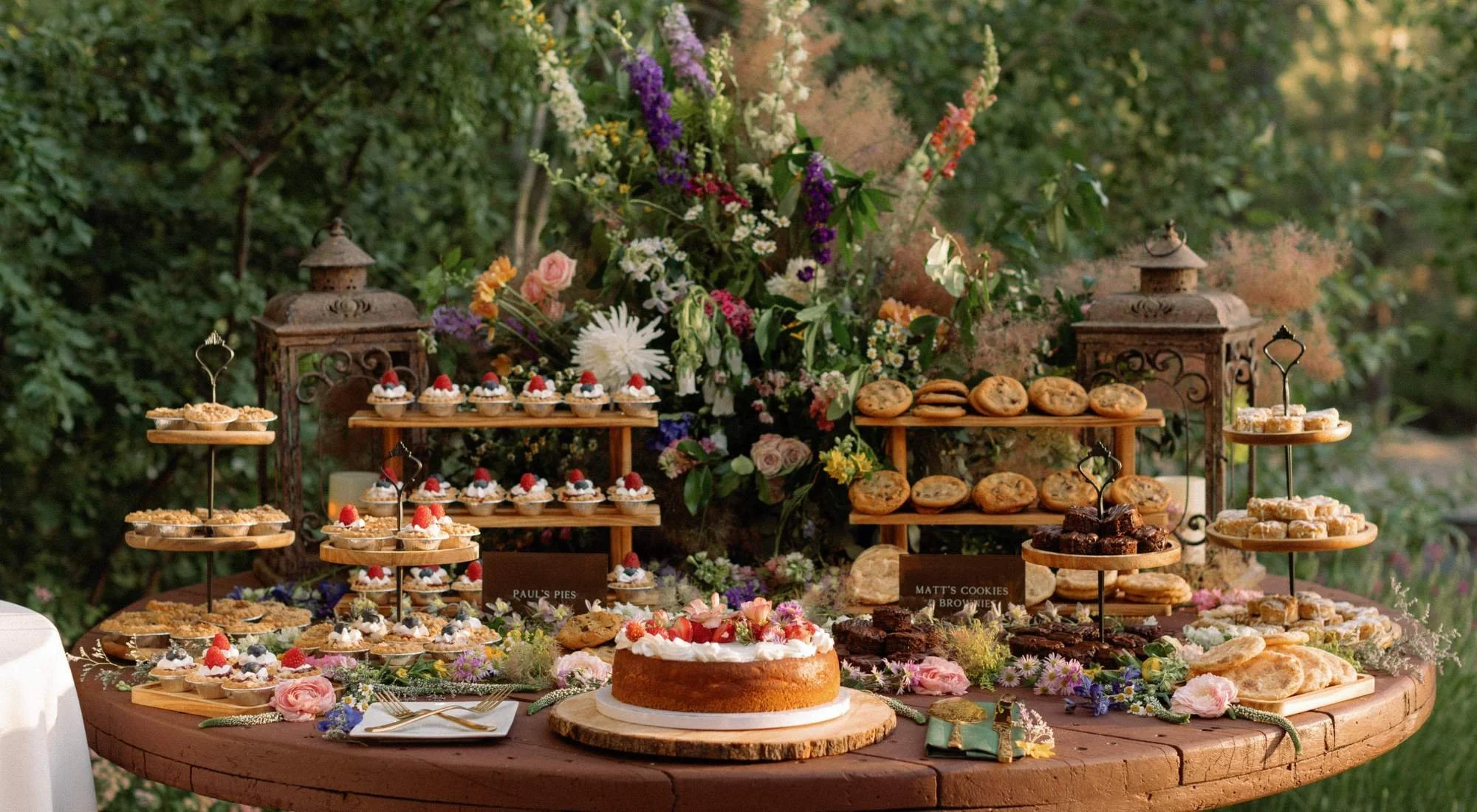
A dessert table without a traditional cake is becoming increasingly popular, and it comes with its own calculation logic. When bite-sized items are the main event, volume adds up quickly because guests are inclined to sample rather than commit to a single large portion.
When there is no cake, plan for three to four mini desserts per guest across your dessert table selections.
Guests will instinctively take a small sampling. A guest who would have taken one slice of cake will often pick up three or four small items when the table offers variety.
Bite-sized items also have a practical advantage. Guests will want to sample everything on offer, while selecting a mix of five types of items works best, keeping the table looking full and abundant without becoming unmanageable.
#3: Cake Plus a Dessert Table
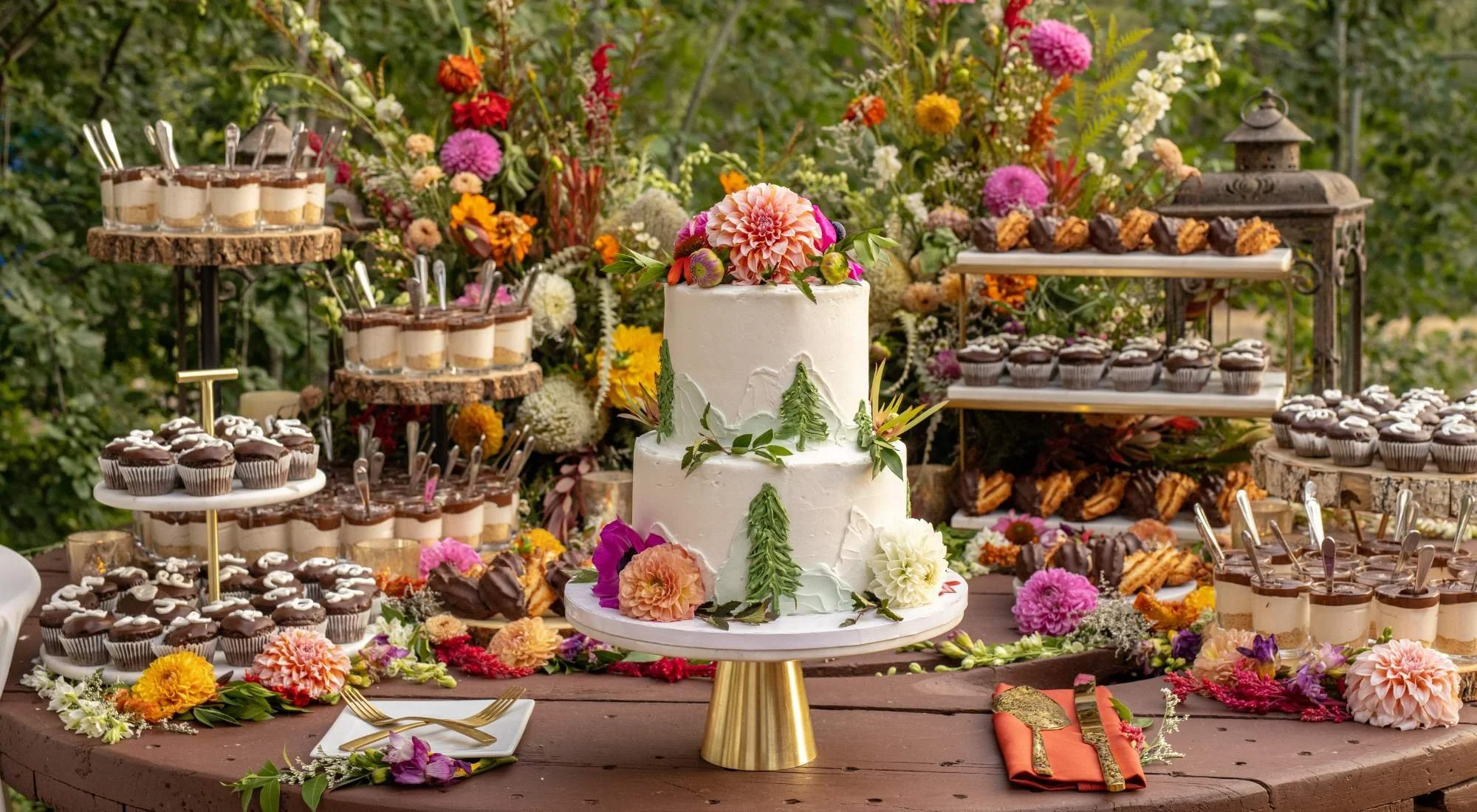
The most common wedding dessert configuration is for both elements to be present. It's also the one most prone to over-ordering.
Having a dessert table alongside a wedding cake doesn't mean you need full quantities of each. It means you need scaled-back quantities of both.
Cake for 75 to 80% of guests paired with two to three mini desserts per person on the side is the best way to estimate.
Each element supports the other rather than competing with it, and guests who would have taken a full slice of cake often take a smaller portion when other options are within reach.
This configuration also lends itself naturally to a late-night dessert moment. Hold back a portion of the table and refresh it later in the evening, once dancing has started. You’ll create a second wave of energy without requiring more food.
It's a touch that elevates the experience at no additional cost.
#4: Plated Dessert Course Plus Cake
A formal plated dessert course following dinner changes the math entirely.
When guests have already been served a complete dessert at their seat, their appetite for a full slice of cake on top of it drops significantly. The cake functions more as a ceremonial centrepiece than a primary dessert in this scenario, and your quantities should reflect that.
Plan one full portion per guest for the plated course. Then scale the cake to 50 to 60% of your total guest count.
The people who genuinely want cake after a plated course will have it, and nothing goes to waste. In this scenario, the cake carries a strong visual impact since it's being cut and displayed at the table rather than leaning on to feed the room.

Other Factors That Affect How Much Dessert Is Enough for a Wedding
Guest count is just the starting point, but several variables will push your numbers up or down regardless of which scenario applies:
Time of day – Evening receptions consistently see higher food and dessert consumption than daytime events. Guests arrive with dinner appetites, expect a full meal, and tend to stay later. Brunch and afternoon weddings play out differently; the overall volume of food guests expect is lower, and dessert participation reflects that.
How heavy the dinner is – A rich, multi-course dinner naturally dampens dessert consumption. A lighter cocktail-style reception, where guests have grazed on small bites rather than sat down to a full plated meal, tends to produce stronger dessert turnout.
Guest demographics – Younger crowds are more likely to eat generously and revisit the dessert table. Older guests and those with health-conscious tendencies tend to eat less. Events with a significant number of children can actually skew lower overall, since kids often eat small amounts of many things rather than committing to a full dessert.
Self-serve vs. tableside service – Dessert placed in front of a guest gets eaten at a much higher rate than dessert that they have to seek out. A staffed dessert station or tableside presentation will consistently outperform an unattended table, particularly later in the evening.
Whether you're planning an intimate micro-wedding or a weekend extravaganza with 400 of your closest friends, Twenty Mile House takes the guesswork out of dessert planning. That means you can focus on the fun part of wedding planning: cake tasting!
FAQs About Wedding Dessert Planning
How Many Desserts for 100 Guests?
For 100 guests with both cake and a dessert table, plan for approximately 80 cake slices and 200 to 250 mini desserts. Without cake, aim for 350 to 450 mini dessert pieces total across your selections with three to four dessert types.
How Many Desserts for a 200 Person Wedding?
For 200 guests with cake and a dessert table, plan for approximately 160 cake slices and 400 to 500 mini desserts. Without cake, plan for 700 to 900 total pieces distributed across your selections. Resist the temptation to add more types of desserts just because the guest list is large.
How Much Does Dessert Cost for a Wedding?
A wedding cake typically runs $3 to $8 per slice, depending on design complexity, tier count, and region, with most couples spending $700 to $1,100 on cake alone.
Mini desserts for a table generally run $2 to $5 per piece. A combined budget covering both cake and a dessert table for 100 guests commonly falls between $1,000 and $2,500, with major metropolitan areas trending noticeably higher.
Confirm per-slice and per-piece pricing with your baker early in the planning process, since custom design elements, sugar flowers, and specialty ingredients all affect the final number.
At Twenty Mile House, our all-inclusive packages are designed to eliminate that kind of line-item uncertainty. Your dessert experience is part of a fully curated celebration, not a separate negotiation.
How Far in Advance Should You Order Wedding Desserts?
Most bakers book four to six months out for peak wedding season.
For May, June, and October weddings specifically, securing your baker at the six-month mark is strongly advised, as dates fill quickly during those months.
For peak-season dates, it’s recommended to book no later than six months out.
If you’re getting married at an all-inclusive wedding venue, your baker will be booked when you book the venue. However, it’s still important to discuss your dessert needs with them well in advance.
Custom designs require the most lead time. Intricate sugar work, fondant decorations, and multi-tiered structures involve design consultations, tasting appointments, and sourcing that simply can't be compressed into a few weeks. Dietary accommodations also benefit from early notice, since specialty ingredients and dedicated preparation protocols require additional planning.
Lock in your baker, confirm the general direction, then return to finalize details as your guest count solidifies.
How Many Dessert Options Do You Need for Guests With Dietary Restrictions?
The answer depends on your specific guest list, but one to two thoughtfully chosen allergy-friendly options cover the majority of wedding guest lists.
The three most common accommodations are gluten-free, dairy-free, and nut-free.
If you’re having children at your wedding, it’s estimated that about 8% of children in the U.S. have a food allergy.
Either way, it can save a lot of trouble (and possibly a life) to include a line on your RSVP cards for guests to note dietary needs.
Share that information with your baker or caterer as early as possible so proper preparation and cross-contamination protocols can be put in place. If a significant portion of your guests requires a specific accommodation, adjust your quantities for that item accordingly.
Tips To Avoid Waste Without Running Short
A few deliberate choices can keep the balance between generosity and waste on the right side of the ledger:
Order for 80 to 85% of your guest count rather than the full headcount.
Have small to-go boxes available so that any remaining food at the end of the evening leaves with guests. Leftover cake and desserts that travel home are a final hospitality gesture that guests genuinely appreciate.
Communicate your final guest count and full dietary picture to your caterer or baker at least two weeks before the wedding. The more precise your numbers, the less margin for error on both sides.
Twenty Mile House Helps You Find the Sweet Spot
Planning how much dessert to order for wedding guests is one of those decisions that feels minor until it isn't, either because the table ran out before the evening peaked, or because the final invoice reflected quantities no one actually needed.
At Twenty Mile House, this is the kind of detail we help couples think through from the beginning, not scramble to resolve at the end.
Our all-inclusive experience is built around the belief that a wedding this extraordinary deserves planning that's just as intentional.
Every element, including the sweet finish, is held to the same standard: considered, beautiful, and entirely your own.
If you're ready to start building a celebration as extraordinary as the commitment it marks, we'd love to hear from you.